Why the Habit of Checking Matters
Artificial intelligence tools have become common fixtures in newsrooms, marketing departments, and small business offices. They draft blog posts, summarize reports, and generate copy at a pace no human writer could match. What they produce often reads smoothly, with confident phrasing and a tone that sounds authoritative. That confidence is exactly why editors and writers who rely on these tools have learned to treat every draft as a starting point rather than a finished product. A well written sentence is not the same thing as a correct one, and the habit of verification has become a defining trait of professionals who use these systems responsibly.
Editors who have worked with automated drafting tools for any length of time describe a particular pattern. The errors rarely look like errors. A wrong name sits in a sentence with the same rhythm as a correct one. A fabricated statistic carries the same measured tone as a real one pulled from a government report. This is part of what makes the discipline of Fact-Check AI output different from traditional proofreading. The task is not simply catching typos or awkward phrasing. It is catching confident, well constructed sentences that happen to be wrong.
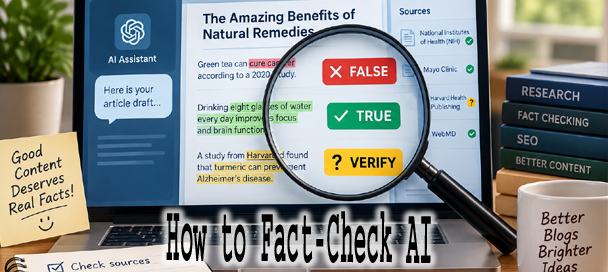
Never publish an AI-generated fact just because it sounds convincing. Check the original source before you trust it. Verify names, dates, quotes, statistics, links, and important claims yourself. AI can be a useful writing assistant, but the person who clicks Publish is responsible for making sure the information is accurate.
Checking Names and Titles
Names are one of the most frequent trouble spots in AI generated writing. A tool might blend two people with similar backgrounds into one, or attach the wrong professional title to a real individual. Consider a case where a piece of writing referred to a nutrition researcher as a licensed physician when her actual credential was a doctorate in food science. The distinction matters, both for accuracy and for the credibility of anyone who publishes the piece without noticing the mismatch. A careful review involves searching for the person independently, confirming their current title, their employer, and the correct spelling of their name across at least two separate sources.
Titles change over time as well. Someone described as a company’s marketing director in an older source may have since become the vice president of communications, or may have left the organization entirely. Part of the discipline behind Fact-Check AI habits is recognizing that a tool trained on data from a fixed point in time has no way of knowing what happened afterward. Cross referencing a name against a recent, dated source closes that gap and prevents outdated information from appearing as current fact.
Verifying Dates and Timelines
Dates are deceptively easy to get wrong because they often appear in a sentence without any obvious signal that something is off. A generated paragraph might state that a piece of legislation passed in a particular year when it actually passed two years earlier, or that an event occurred before another event that in reality came first. One illustrative case involved a summary of a company’s history that placed its founding a full decade too early, an error that likely came from confusing the founding of a related business with the company being described.
Timelines compound this risk because a single incorrect date can distort everything that follows in a narrative. If an article claims a policy took effect before the underlying law was even passed, the entire cause and effect structure of the piece falls apart. Verifying dates means checking primary sources such as official announcements, court records, or dated news coverage rather than relying on a secondary summary. This single step, applied consistently, prevents a surprising number of embarrassing corrections after publication.
Confirming Quotations
Quotations deserve particular scrutiny because they carry the weight of firsthand testimony. A reader assumes that anything placed in quotation marks reflects exactly what a person said. AI writing tools sometimes paraphrase a real statement and present it as a direct quote, or combine fragments from different points in a conversation into a single sentence that the speaker never actually said. In one notable instance, a widely circulated line from a film was attributed to the wrong character entirely, a mistake that spread across several unrelated pieces of content before anyone traced it back to its source.
The remedy is straightforward in principle, if occasionally tedious in practice. Every quotation should be traced to its original appearance, whether that is a video recording, a published interview, a court transcript, or a press release. If the exact wording cannot be located and confirmed, the safer choice is to paraphrase the idea without quotation marks rather than risk publishing words that were never actually spoken. This precaution sits at the center of any serious approach to Fact-Check AI output before it reaches an audience.
Checking Statistics and Numbers
Numbers carry an air of precision that makes them especially persuasive, and especially dangerous when they are wrong. A generated draft might state that a particular industry grew by a specific percentage over a specific period, complete with a figure that sounds entirely plausible. In one case, a summary of a regional housing market cited a price increase nearly double the actual figure reported by the local real estate association, likely because the tool blended data from two different time periods or two different regions.
Verifying a statistic means locating the original dataset or report the figure claims to come from, not simply searching for the number itself, since incorrect figures often get repeated across multiple secondary sources once they enter circulation. A reliable statistic should be traceable to a named organization, a specific study, or a government agency, along with the year the data was collected. When that chain cannot be established, the safest approach is to either remove the figure or replace it with a general description that does not rely on a specific number that cannot be confirmed.
Check Out Our The Free Article Fact Checker
Testing URLs and Links
Links included in AI generated content present a different kind of risk, since a tool may construct a URL that looks structurally correct but leads nowhere, or leads to a page entirely unrelated to what the text claims. A generated article once referenced a government health agency page that, upon inspection, redirected to an unrelated archive from several years earlier, likely because the specific page referenced had since been reorganized or removed. Publishing a broken or misleading link undermines the credibility of the surrounding content, even when the written claim itself is accurate.
Testing every link before publication is a simple mechanical step that catches this problem reliably. Each URL should be opened directly, confirmed to load, and reviewed to ensure the destination page actually supports the claim it is attached to. When a generated citation cannot be matched to a real, working page, the safest option is to remove the link and rely on a verified alternative source instead, rather than leaving a placeholder that misleads readers into thinking a claim has been documented when it has not.
Here is a FREE universal verification prompt that works with ChatGPT, Gemini, Claude, or another AI that has access to current sources. It should also force the AI to admit when something cannot be verified instead of filling the gap.
Act as a careful professional fact-checker. Review the content I provide below and verify every factual claim that can reasonably be checked.
Do not assume a statement is correct because it sounds believable. Do not invent missing information, sources, quotations, URLs, or explanations.
CHECK ALL OF THE FOLLOWING:
1. NAMES AND IDENTITIES
Verify the spelling of every person’s name, company, organization, place, product, book, movie, publication, and other named subject. Check that people are correctly identified and that titles, occupations, credits, and affiliations are accurate.2. DATES AND TIMELINES
Verify birth dates, death dates, publication dates, release dates, event dates, historical dates, years, ages, and chronological claims. Check whether the timeline makes sense when several dates are mentioned together.3. QUOTATIONS
Verify every direct quotation. Find the original or a reliable source whenever possible. Confirm that the quoted person actually said or wrote it and that the wording has not been altered or taken out of context. If you cannot verify a quotation, clearly mark it UNVERIFIED.4. STATISTICS AND NUMBERS
Check percentages, prices, measurements, populations, rankings, totals, distances, financial figures, vote counts, sales figures, scientific numbers, and other numerical claims. Check the math when one number is calculated from another.5. LINKS AND URLs
Check every URL. Confirm that the page exists, works, goes to the stated destination, and actually supports the claim associated with it. Flag broken links, redirects to unrelated pages, outdated pages, and sources that do not support the statement.6. SOURCES AND CITATIONS
Verify that every cited source actually exists. Prefer original and authoritative sources such as government agencies, universities, official organizations, primary documents, established reference works, and direct statements. Do not treat an AI-generated citation as genuine until you confirm it exists.7. FACTUAL CLAIMS
Check factual statements throughout the content, including historical events, locations, job titles, credits, ownership, relationships, scientific claims, technical information, and statements about what happened, when it happened, or who was involved.8. CURRENT INFORMATION
Identify information that may have changed since the content was written. Check current positions, company information, prices, laws, statistics, website addresses, product availability, and other time-sensitive claims against current sources.9. INTERNAL CONTRADICTIONS
Look for places where the content contradicts itself. Compare names, dates, ages, numbers, locations, and descriptions appearing in different parts of the text.10. UNSUPPORTED CERTAINTY
Flag statements presented as established facts when reliable evidence only supports them as estimates, allegations, opinions, disputed claims, traditions, or possibilities.FOR EACH PROBLEM FOUND, REPORT:
• ORIGINAL CLAIM: Copy the claim being checked.
• VERDICT: Use VERIFIED, INCORRECT, MISLEADING, OUTDATED, UNVERIFIED, or NEEDS CONTEXT.
• WHAT IS WRONG: Explain the problem clearly.
• CORRECT INFORMATION: Give the corrected information when it can be established.
• SOURCE: Give the source used to verify or correct the claim, including a working link when available.
IMPORTANT RULES:
• Never create a source, quotation, citation, statistic, date, or URL.
• If reliable sources disagree, tell me they disagree and explain the difference.
• Distinguish confirmed facts from reasonable assumptions.
• Use primary sources when they are available.
• For important claims, compare more than one reliable source when practical.
• Do not rewrite the article while fact-checking it.
• Do not silently correct mistakes.
• Do not waste space listing ordinary statements that are clearly correct unless verification is useful.
• If you cannot independently verify something, say so plainly.FINISH WITH:
FACT-CHECK SUMMARY
Give me:
• Number of claims checked
• Number verified
• Number incorrect
• Number misleading or needing context
• Number outdated
• Number that could not be verified
• Broken or questionable links found
• Quotations that could not be authenticated
• The most important corrections I should make before publishingThen give the content an overall factual reliability rating from 1 to 10 and briefly explain the rating.
CONTENT TO FACT-CHECK:
[PASTE YOUR ARTICLE OR OTHER CONTENT HERE]
Verifying Product Information
Content involving products, whether for a review, a comparison piece, or a buying guide, depends heavily on accurate technical detail. AI tools sometimes describe a product’s specifications using information from an earlier model, or mix features from two competing products into a single description. One example involved a description of a kitchen appliance that listed a capacity and wattage that matched a similar but discontinued model, rather than the current version being sold at the time of writing.
Manufacturer specification sheets, official retail listings, and the product packaging itself remain the most reliable sources for this kind of detail. Pricing in particular changes frequently and should never be treated as fixed once written, since a figure accurate at the time a tool was trained may be outdated by the time an article is published. A methodical review of product claims against a current, official source protects both the credibility of the content and the trust of anyone relying on it to make a purchasing decision.
Handling Medical and Legal Claims With Extra Care
Claims touching on health or law carry consequences that extend well beyond a simple correction. A generated passage might describe a supplement as effective for a particular condition, or summarize a legal requirement in a way that sounds definitive but omits an important exception or regional variation. In one instance, a piece of content described a workplace safety regulation as applying nationally when it was in fact specific to a single state, a detail that could have led a business owner to believe they were compliant when they were not.
These categories deserve a higher standard of verification than most other content types. Medical claims should be checked against peer reviewed research or guidance from recognized health authorities, not general summaries. Legal claims should be checked against the actual text of a statute or regulation, ideally with attention to the jurisdiction involved, since laws vary significantly from one region to another. Content in these categories that cannot be fully verified is better left unpublished or reframed in more general, clearly non-specific terms until confirmation is available.
Tracing Citations That AI Tools Generate
Perhaps the most distinctive challenge in this entire process involves citations that an AI tool presents as academic or journalistic sources. These citations often include a plausible sounding author, a journal name, a publication year, and even a page range, all formatted correctly, yet the source itself does not exist. One case involved a citation attributed to a well known academic journal, complete with a volume number and issue, describing a study that had never actually been published under that title by that author.
Every citation generated by an AI tool needs to be searched independently in a library database, an academic search engine, or the publication’s own archive before it appears in finished content. If a citation cannot be located through an independent search, it should be treated as fabricated until proven otherwise, regardless of how convincing its formatting looks. This particular step has become one of the more time consuming parts of the Fact-Check AI process, but it is also one of the most important, since a fabricated citation can quietly damage the credibility of an entire piece of writing once a reader or fellow researcher attempts to track it down and finds nothing there.
Building a Consistent Verification Routine
None of these individual checks carries much weight on its own if it is applied only occasionally. The professionals who handle AI generated writing most reliably treat verification as a fixed stage in their process, applied to every piece regardless of how polished the draft appears or how much time pressure exists before publication. A short internal checklist, covering names, dates, quotations, statistics, links, product details, medical or legal claims, and citations, gives a writer or editor a consistent structure to follow rather than relying on memory or instinct in the moment.
Over time, this routine becomes less about suspicion and more about craftsmanship. A writer who has practiced Fact-Check AI habits across dozens of articles begins to recognize the specific patterns where a generated draft tends to drift from accuracy, and can focus attention there first rather than treating the entire document with equal scrutiny. That efficiency does not replace thoroughness, but it does make the process sustainable for anyone producing content regularly, which is precisely the balance that responsible publishing in this era requires.